 Вход
Вход
 Регистрация


TL;DR
Your funnel doesn’t break when you scale — your Telegram infrastructure does. Meta delivers traffic in aggressive bursts, and if you’re running a single bot with no buffer, it will throttle, drop events, and wreck your attribution. The only way to scale cleanly is with autoscaling bot pools and pre-generated invite link reserves built to absorb the spikes.
Why Scaling Feels Like Hitting a Wall
Every Telegram campaign looks easy when you’re spending $500/day.
But when you push to $2,000 or $5,000/day, things get weird.
- Join confirmations get stuck.
- Cost per subscriber randomly spikes.
- You see more “organic” joins that should have been attributed to ads.
Most buyers blame creative fatigue or bad audiences.
Usually, it’s neither. Your tracking software just couldn’t handle the traffic.
Why Generic Trackers Fail at Scale
Most Telegram trackers are built for “steady state” traffic. They work fine when you are spending $500/day because the click volume is manageable.
But they fail under pressure because they ignore a hard limit: Telegram’s API Bottleneck.
A single bot can only generate a limited number of invite links per second.
When you scale on Meta, traffic doesn’t grow linearly. It comes in violent bursts. You might get 500 clicks in 60 seconds after a successful bid.
Standard trackers handle this by trying to generate 500 links on demand, one by one.
- Result 1 (Latency): The user waits 300ms+ for the API to respond. They bounce.
- Result 2 (Rate Limits): Telegram blocks the bot for spamming requests. The links stop working entirely.
While your dashboard shows “Active,” your tracker is actually rejecting your most valuable traffic.
What Happens When the Bot Chokes
When you hit bot throughput limits:
- Join confirmations delay.
- Some users fail to receive working links.
- Some invite links temporarily throttle.
- Attribution reconciliation fails.
- Conversions are undercounted.
To you, it looks like:
- Conversion rate dropped.
- CPL increased.
- Creative stopped working.
But the traffic didn’t degrade.
Your system couldn’t process it fast enough.
This is exactly why we built TG Tracker. We saw high-volume media buyers losing 20-30% of their conversions during peak hours simply because their tracking stack was single-threaded.
The Meta Burst Problem
Meta does not deliver traffic linearly.
When its algorithm detects performance pockets, it:
- Accelerates delivery.
- Forces budget pacing.
- Pushes traffic in dense clusters.
If your infrastructure expects:
“steady 5 clicks per second”
But Meta sends:
“80 clicks in 10 seconds”
You get mismatch failure.
Under burst pressure:
- Real-time invite generation fails.
- Join detection queues build up.
- Some sessions expire before matching.
Scaling traffic exposes architectural weakness. Unlike standard tools that crash under load, TG Tracker uses an elastic event ingestion layer engineered specifically to absorb these bursts without data loss.
Single Bot Invite Link Generation
Most basic tracking setups rely on a single bot to generate links for your channel.
This is a structural flaw. Telegram applies rate limits per bot, not per channel.
If you rely on a standard tracker that uses one bot to generate links for every click, you have a hard ceiling on your growth. When Meta sends a burst, that single bot hits its limit and stalls.
This is the default setting for almost every competitor on the market.
Users experience:
- Delayed redirects (waiting for API response).
- Broken links (when the generator fails).
- Failed joins (due to timeout).
Every extra second reduces conversion rate.
The auction doesn’t wait for your bot.
This infrastructure failure is expensive. Advertisers relying on single-bot setups pay a “latency tax” of 10-25% in inflated CPL simply because their tooling cannot ingest traffic as fast as Meta delivers it.
How TG Tracker Handles This: Distributed Bot Pools (Autoscaling Bots)
TG Tracker does not rely on a single bot to generate invite links. Instead, it supports a Distributed Bot Pool architecture where multiple bots operate inside the same Telegram channel.
Each bot can generate invite links at a limited rate. In practice, one bot can safely create roughly one invite link every ~0.33 seconds. During traffic bursts, a single bot quickly becomes a bottleneck.
To solve this, users can add multiple autoscaling bots to the channel. All bots work in parallel to generate invite links.
- Parallel Link Generation: Each bot generates invite links independently. More bots increase total throughput.
- Burst Handling: Traffic spikes from ad platforms can be absorbed because multiple bots are creating links simultaneously.
- Horizontal Scaling: Telegram allows up to 50 bots in a channel, meaning the link generation capacity can scale significantly.
- Operator-Controlled Scaling: Instead of hiding the mechanism, users explicitly add additional bots to increase capacity.
Because invite link creation is distributed across multiple bots, the system avoids the rate limits that occur when a single bot is responsible for handling all traffic.
The Speed Advantage: Pre-Generated Link Reserves
Other trackers are trying to create links after the user clicks (causing delays)
TG Tracker uses Pre-Generated Invite Pools.
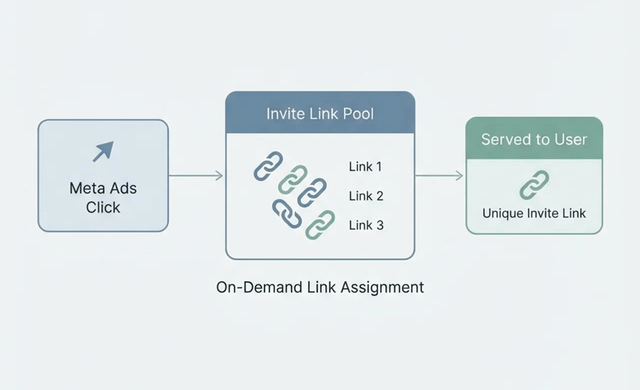
Our system continuously generates thousands of unique invite links in the background and keeps them in a high-speed cache. This “Link Buffer” technology is unique to TG Tracker and ensures that even if Telegram’s API slows down, your ads don’t.
When a user clicks your ad:
- We instantly assign a link from the reserve.
- The user is redirected in milliseconds.
- We replenish the pool in the background.
The Result: Zero waiting time for the user. Zero API dependency at the moment of the click.
What Scaling Without This Looks Like
Without bot autoscaling and link pools:
At $1,000/day → works.
At $3,000/day → unstable.
At $7,000/day → breaks.
Symptoms:
- CPL creeps up.
- Organic attribution increases.
- Verified joins decrease.
- Buyers panic and pause campaigns.
The campaign didn’t die.
The infrastructure failed.
Why This Matters for Media Buyers
If your tracking layer collapses under burst traffic:
- You misread creative performance.
- You cut winning ads.
- You lower budgets prematurely.
- You operate below your true scaling ceiling.
Competitors with resilient infrastructure:
- Absorb bursts.
- Maintain stable join rates.
- Scale budgets confidently.
- Outbid you in the same auction.
The difference is not creative.
It is operational tolerance.
Strategic Takeaway
Telegram does not “stop converting” at scale.
Single-bot tracking setups do.
If you are spending aggressively on Meta or TikTok, your infrastructure must handle:
- Burst delivery.
- High concurrency.
- Bot throughput limits.
- Invite link exhaustion.
Scaling paid traffic is not just about bidding strategy.
It is about ensuring your tracking layer does not become the bottleneck.
When infrastructure keeps up with the auction,
CPL stays stable.
Attribution stays clean.
Scale becomes predictable.